
The AI Moment Is Here. And It Has Your Name on It.
Apr 14, 2026What AI's rise actually opens up for Professionals of Color — and how to step into this moment with intention not anxiety.
Van Tran, Founder & CEO of Career Rising
6 min read
AI, AI, AI. Lately, every conversation I've been in — online, at family dinners, with peers and clients — keeps circling back to the same topic: AI and what it means for our careers. If you don't already know I love a good rabbit hole. Let's dive in together.
Here's what I want you to hold onto before we get into the data: this moment, as disruptive as it is, also carries real opportunity. Not the kind that gets handed to you — the kind you can build deliberately.
On Friday, Executive Coach and Global Talent Advisor Dipali Chakravarti and I are sitting down for a live, candid conversation about promotion planning — the kind of intentional strategy that turns a dangled opportunity into a real one. Join us Friday, April 24th. But first, the rabbit hole.
We know AI is moving fast. Faster than policy, faster than most organizations, and honestly faster than many of us feel ready for. But here's the thing about fast-moving moments: they create openings. The question is who's positioned to step into them.
The opening is real — if we move toward it
Skills-based hiring is one of the most significant structural shifts happening in the labor market right now. 55% of employers have already moved to skills-based models, with another 23% planning to within the year. For Professionals of Color who have historically been screened out by credential and pedigree-based systems, that is a genuine opening — not a guarantee, but a door that wasn't always there.
Add to that: workers with advanced AI skills are earning 56% more than peers in the same roles without them. LinkedIn's Work Change Report shows AI skills added to member profiles jumped 80% in the past year, and engagement in AI learning courses grew 167%. People are moving. The momentum is building. And yet, companies are sill struggling to hire individuals with the right combo of skill sets. So there's still time to be part of this wave.
AI fluency is becoming a baseline — not a competitive edge, but a prerequisite for job continuity and access to the fastest-growing roles. That's not a reason for panic. It's a reason to move with intention, starting now.

A rabbit hole moment: the gender data
A few weeks ago, I came across a LinkedIn post that Jennifer Betts, CEO of Magnar Metals, shared during Women's History Month. She was citing new research out of Harvard Business School: women are adopting generative AI at approximately 25% lower rates than men. The research — drawing from 18 studies across more than 140,000 individuals worldwide — found that the gap wasn't about access or aptitude. It was about ethics concerns, fear of judgment, and workplace cultures that haven't yet made it safe to experiment.
I sat with that. Because what I heard underneath the gender data was something I already knew to be true more broadly: the barriers to AI adoption are not primarily technical. They are cultural, structural, and psychological. And they do not fall evenly.
I would love to see equivalent research on adoption by race and ethnicity. I suspect we already know what it would show. But here's what matters: if the hesitancy is rooted in culture, values, and psychological safety rather than capability, we can make room for it, and still pursue fluency. That's actually good news.
In my conversations with Career Rising members and peer professionals — many of whom are not in technical roles — I hear genuine curiosity about AI. People want to learn. But that desire keeps getting kicked down the road: later, when things slow down, when there's more time, when it feels less overwhelming. And then later arrives, and you find yourself behind.

What's at stake — and why it matters now
I want to be honest with you, because I think you deserve that more than reassurance. Gartner predicts that through 2026, 20% of organizations will use AI to flatten their structures — eliminating more than half of current middle management positions. Middle management is the tier where many Professionals of Color are concentrated, after years of hard-won advocacy and sacrifice.
At the same time, Gartner anticipates that 39% of the workforce will face role changes and redeployment in the next two to five years, yet less than 155 of at-risk workers currently have access to employer-sponsored reskilling programs (SHRM / Finflowmax).
That sounds daunting. But redeployment also means reinvention — and the professionals who will navigate that reinvention with the most agency are the ones who've been building new skills deliberately.

AI is not inherently equitable. Systems moving at speed, without an equity lens, have a way of encoding existing inequities and accelerating them. Research from McKinsey and the International Economic Development Council confirms the impact of AI on employment is not race-neutral or gender-neutral. If folks with advanced AI skills are earning 56% more than their counterparts without that fluency, you will continue to see a widening of of the wealth gap. That's the reality. And knowing the reality is exactly what positions you to navigate it on your own terms.
What you can actually do
FOR PROFESSIONALS OF COLOR
I want to speak to you directly — not to alarm you, and not mask what's real with false positivity. What I want to give you is a clear-eyed sense of where your agency lives in this moment.
Your hesitancy about AI — if you feel it — is not a character flaw. It is pattern recognition. Workplaces have historically penalized people like us for being wrong, for experimenting, for needing more than what was offered. The Harvard research showed that women's ethical hesitancy around AI isn't irrational — it's a response to real signals. The same is true for many Professionals of Color. Your instincts make sense. You're values are important.
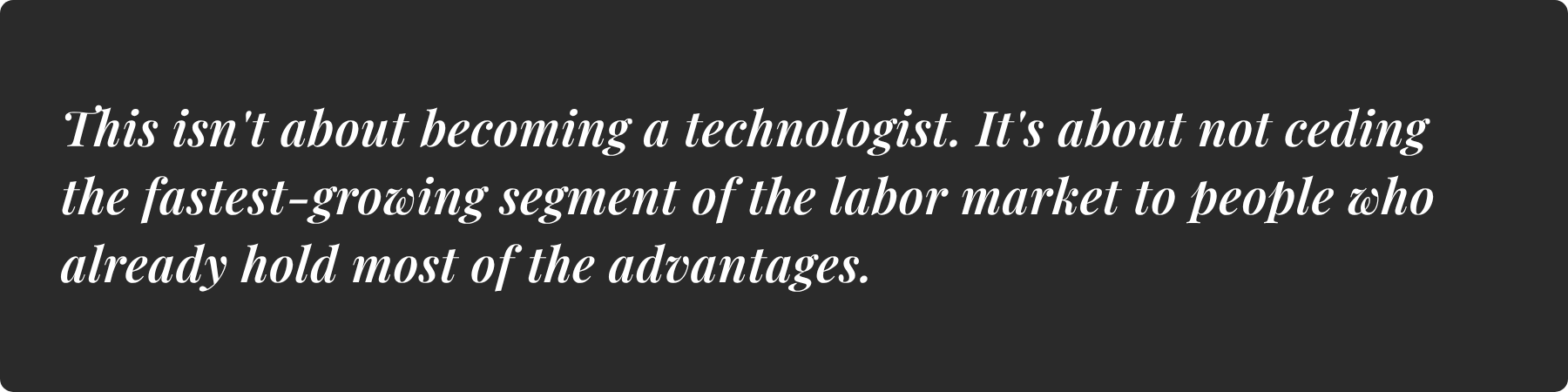
And yet. This moment still requires action. Not because the tools are perfect — they aren't. Not because the playing field is level — it isn't. But because AI fluency is about being in the room when the systems that shape our careers are being built. It's about not ceding that ground.
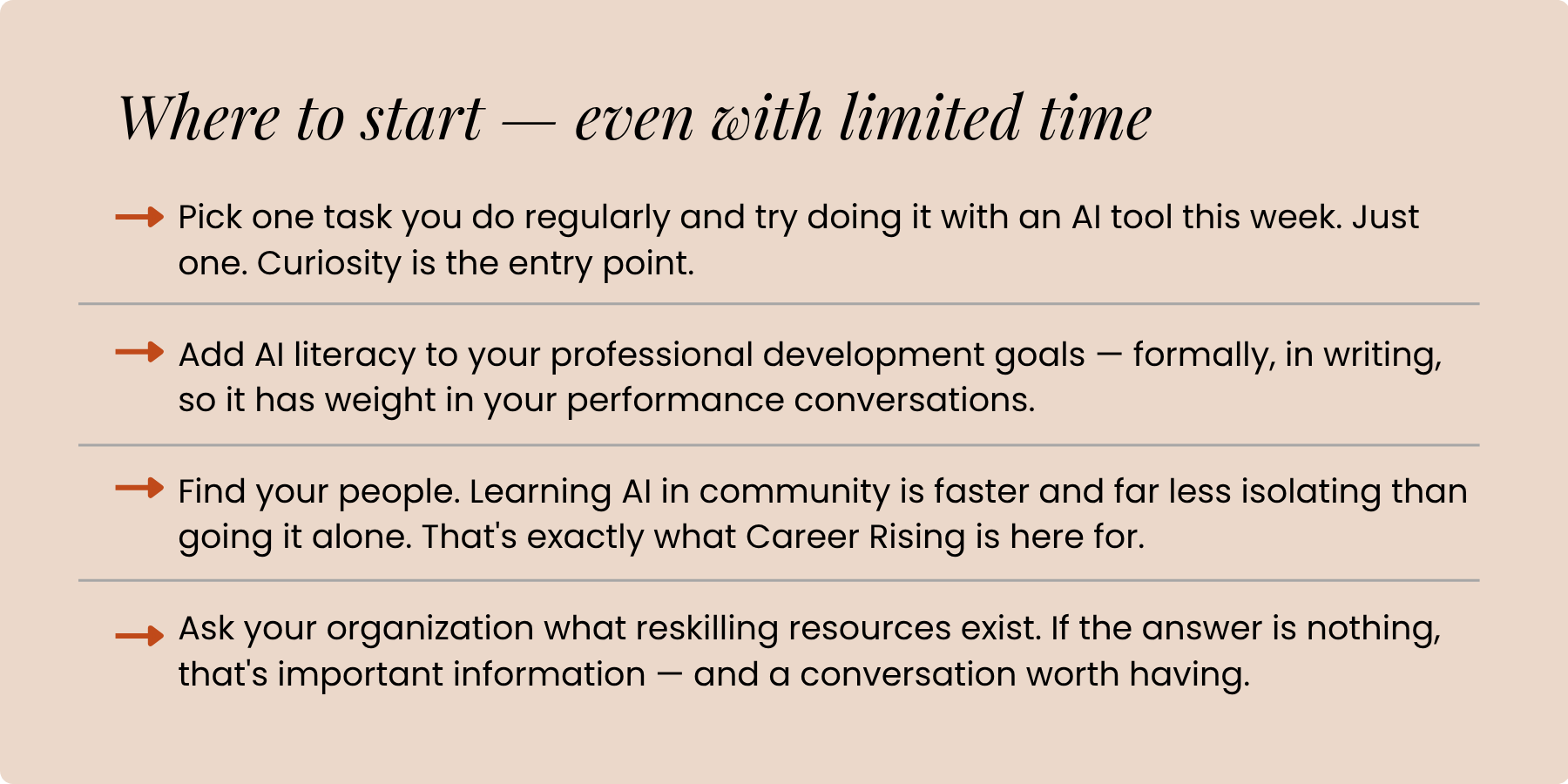
The intention-action gap is real — I see it every day. But the gap closes one small move at a time. You don't have to learn everything. You have to start somewhere. Let's do it together.

Van Tran is the Founder and CEO of Career Rising, a leadership consulting and advisory firm serving executives, senior leaders, and HR professionals committed to advancing leadership and workplace equity.
SOURCES
- Harvard Business School Working Paper — "Global Evidence on Gender Gaps and Generative AI" (Otis, Delecourt, Cranney, Koning) — women adopting AI at 25% lower rates; 140,000 individuals across 18 studies hbs.edu
- Workday Global Study — skills-based hiring adoption (55% current, 23% planned)
- PwC 2025 Global AI Jobs Barometer — 56% wage premium for workers with advanced AI skills
- LinkedIn 2025 Work Change Report — 80% increase in AI skills on profiles; 167% growth in AI course engagement; 70% of job skills will change by 2030
- Gartner — 20% of organizations flattening structures, eliminating 50%+ of middle management; 39% of workforce faces disruption in next 2–5 years
- McKinsey & International Economic Development Council — AI employment impact is not race-neutral or gender-neutral
- SHRM 2026 CHRO Priorities Report / Finflowmax — reskilling access gap (<15% of at-risk workers)
Stay connected with news and updates!
Join our mailing list to receive the latest news and updates from our team.
Don't worry, your information will not be shared.
We hate SPAM. We will never sell your information, for any reason.